
Is It OK to Use an AI Resume Writer? An Honest 2026 Answer
Short answer: yes, it is OK — and it is now normal. Using an AI resume writer to sharpen wording, match a job description, and pass formatting checks is closer to using spellcheck than to cheating. What is not OK is letting AI invent experience you do not have.
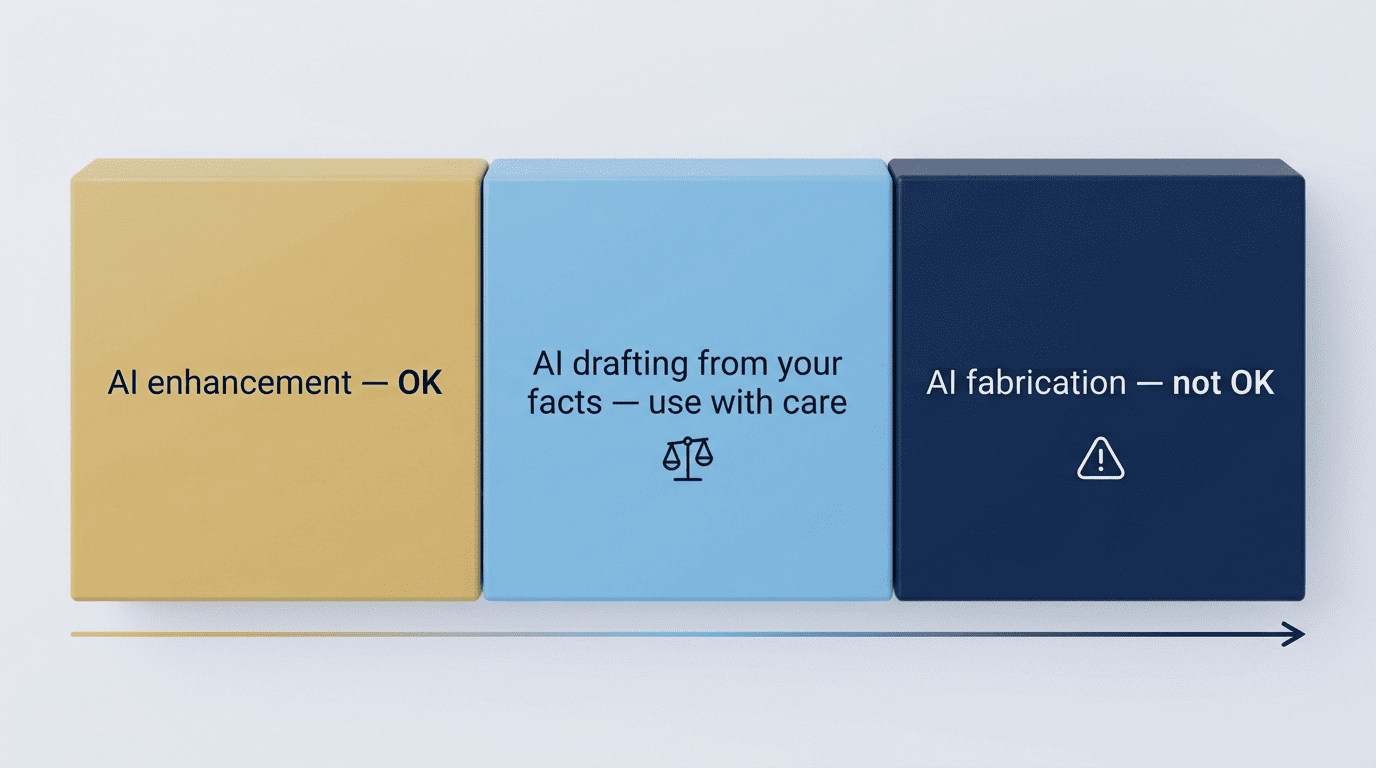
The honest catch is that «OK» depends entirely on how you use it. This guide separates what recruiters actually care about from the panic online, using recent hiring research, so you can use an AI-generated resume confidently without tripping the one thing that really sinks candidates.
Is Using an AI Resume Writer Cheating or Unethical?
The ethics question has a clean dividing line that every major source agrees on: AI-assisted is fine; AI-fabricated is not.
The line: polishing real experience vs. inventing it
Using AI to phrase and polish real experience is broadly accepted — the same principle as hiring a professional resume writer to present your actual background persuasively. Nobody calls that cheating, because the facts on the page are still yours. AI can improve compression, tighten a bullet, and make a scattered work history read clearly. It cannot create signal that was never there.
The danger shows up when people let the tool fill in gaps instead of facts: a fake university name, an inflated job title, a metric nobody checked before it shipped on the page. That is where an AI-assisted resume quietly becomes an AI-fabricated one, and it is the only version of «using AI» that is genuinely unethical.
An AI resume writer is a drafting and formatting aid, not a substitute for real qualifications. It can help you present your actual experience clearly and pass ATS formatting checks — it cannot manufacture a work history, guarantee an interview, or promise a job offer. Treat every AI-suggested line as a claim you must be able to prove and explain in person.
Do you have to disclose that you used AI?
Generally, no. Using an AI-generated resume tool is treated the same way as running spell-check, using Grammarly, or working with a professional resume writer — none of those require a disclosure line on the document itself. Disclose only if a specific application explicitly asks whether you used AI, and answer honestly if it does.
That said, read each posting’s rules before you assume silence is safe. In multiple employer surveys, a large share of hiring teams say they’d like clearer policies on how candidates use AI in applications, which means the rules vary a lot from one company to the next — what’s a non-issue at one employer could be a stated dealbreaker at another.
Can Recruiters or the ATS Tell You Used AI?
The fear is mostly misplaced. The machine that filters your resume is not an AI detector, and the tools that claim to detect AI are unreliable.
The ATS is a database, not an AI detector
An applicant tracking system, as Wikipedia’s overview of the technology describes it, is software that lets employers collect, sort, search, and filter job applications electronically — a database with keyword search, not a content-quality judge. No mainstream applicant tracking system — Greenhouse, Lever, Workday, iCIMS, or Taleo — includes AI-content detection. An ATS parses your resume into fields, indexes the text, and ranks candidates by keyword match. It was never built to score writing style or flag machine-generated prose, and it does not auto-reject you for an «AI score,» because no such score exists in these systems.
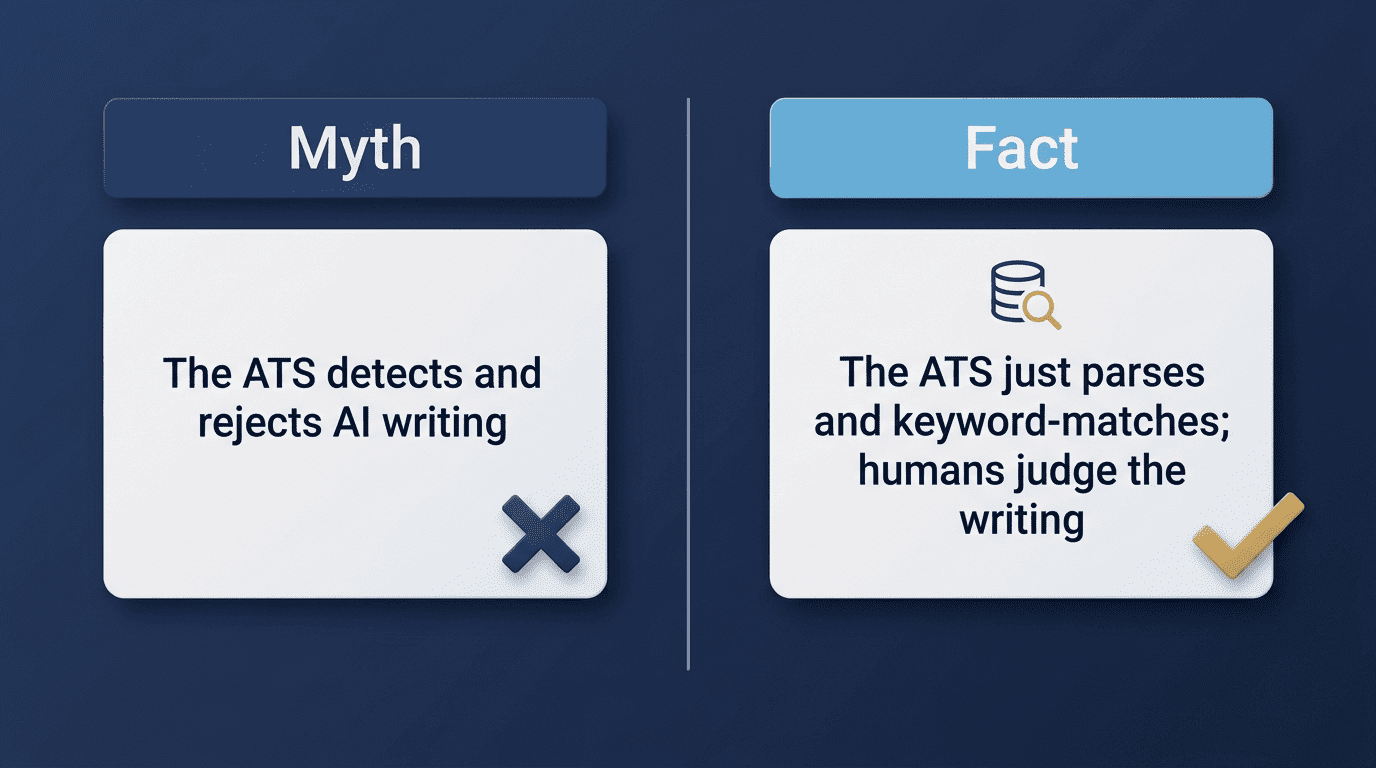
That doesn’t mean formatting is irrelevant. Most large employers run some form of ATS, so a resume that parses cleanly — standard headings, no tables inside a PDF, text the software can actually read — still matters enormously. It just matters for parsability, not for catching AI use.
Why AI detectors can’t be trusted
Standalone AI detectors are a different story, and their track record is worse than most job seekers assume. Tools such as GPTZero, ZeroGPT, and Originality.ai have all misfired on plainly human text — public tests have had detectors rate the U.S. Declaration of Independence and the U.S. Constitution as majority AI-generated, even though both documents predate the concept of AI by two centuries. Detectors also disproportionately misflag writing from non-native English speakers and neurodivergent writers, penalizing sentence patterns that are simply different, not synthetic.
AI detectors don’t work.
MIT Sloan Teaching & Learning Technologies
Stanford HAI researchers found that popular detectors misclassify essays written by non-native English speakers as AI-generated at far higher rates than essays from native speakers — precisely the kind of false positive that could unfairly cost someone an interview. Even OpenAI walked away from the idea, shutting down its own AI-text classifier in 2023 and citing a low rate of accuracy. If the company that built the underlying models couldn’t make reliable detection work, a browser extension almost certainly can’t either. Given that unreliability, essentially no recruiter is running your resume through a detector and rejecting you on the score.
What recruiters actually react to: «sameness»
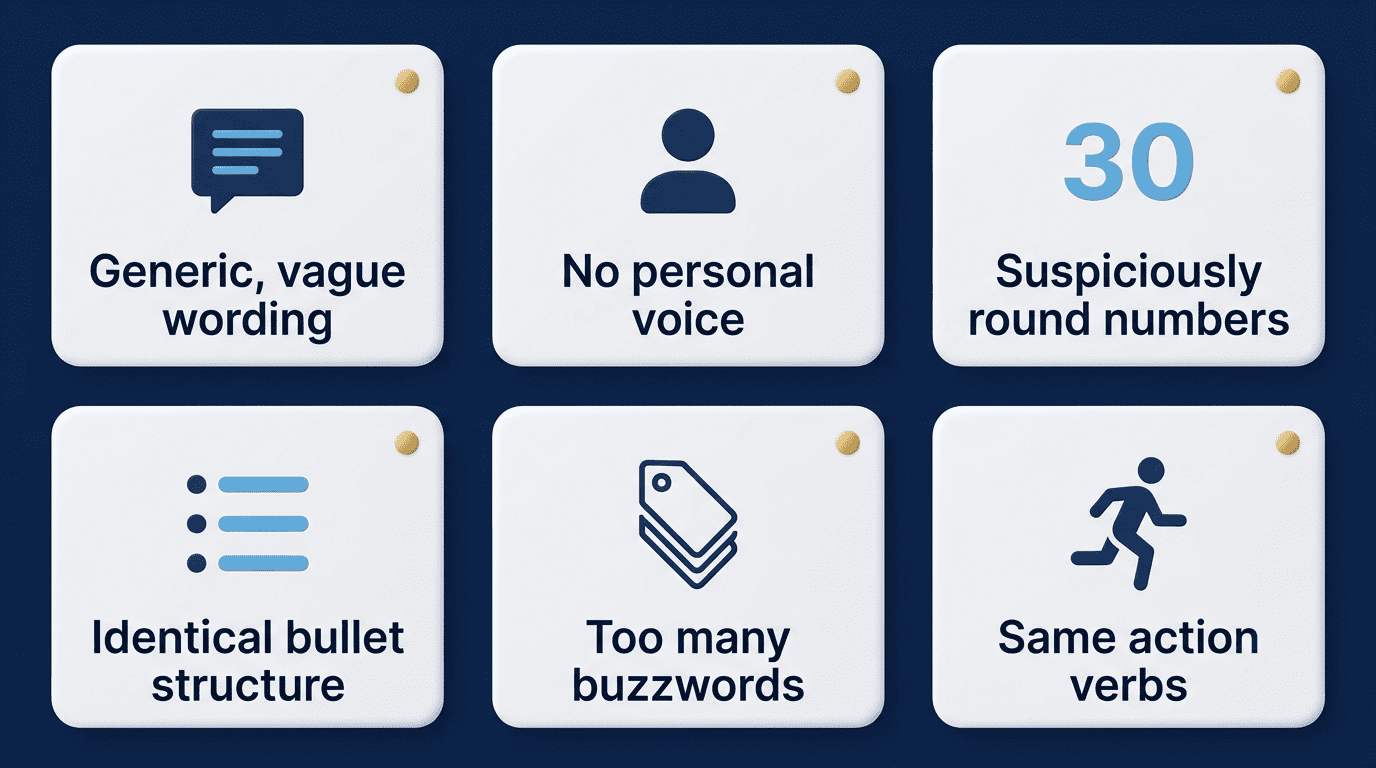
What actually gets a resume noticed — for the wrong reasons — is generic sameness, not AI use itself. Recruiters read hundreds of resumes a week, and certain patterns repeat until they become tells: identical action verbs like drove, owned, spearheaded, championed, and partnered; suspiciously round, clean numbers; and prose that has had every trace of a personal voice sanded off. A notable share of hiring managers say they can spot AI-flavored content within seconds of scanning a page, and it’s rarely because a tool flagged it — it’s pattern recognition built from reading too many resumes that all sound the same.
Five tells show up most often, and every one of them is fixable without touching the AI question at all:
- Vague or generic language instead of specific detail
- Grammatically perfect sentences with zero personality
- Achievements that sound impressive but stay unspecific
- Identical bullet-point structure from top to bottom
- Buzzword density that doesn’t match the candidate’s actual seniority
They’re symptoms of copy-pasting ChatGPT or another AI resume tool’s output verbatim instead of editing it into your own voice.
Do Employers Actually Care? What Recent Data Says
Employers are split, and — importantly — many of them are using AI too. The reaction is less about «you used AI» and more about «your resume is generic or unverifiable.»
The numbers: adoption vs. rejection
Surveys on this exact question genuinely disagree with each other — a byproduct of different sample sizes, different definitions of «used AI,» and a norm that keeps shifting month to month. Treat every figure below as a directional signal from one survey, not a fixed industry rule: different surveys have put the share of employers who’d reject a purely AI-written resume anywhere from roughly one in five to well over half, depending on who was asked and how the question was worded.
| What was measured | Rough pattern across surveys |
|---|---|
| Job seekers who used ChatGPT/GenAI anywhere in their search | roughly half, in several recent surveys |
| Candidates who used AI specifically to draft a resume, year over year | a rising minority, climbing noticeably each year |
| Employers who’d reject a resume that reads as purely AI-written with no personalization | estimates range widely, from a meaningful minority to a majority |
| Employers/recruiters using AI in their own hiring or screening process | a strong majority, by most industry surveys |
The pattern across these numbers is the same regardless of exact figures: adoption is high on both sides of the hiring desk, but rejection tracks quality and personalization, not the mere presence of AI-assisted writing.
The «resume illusion»: passing the machine, failing the human
A widely cited Robert Half survey of hiring managers put a name to the friction: the «resume illusion» — the growing gap between what a resume claims and what a candidate can actually demonstrate once they’re in front of a person. In that survey, a large majority of HR leaders said AI-written applications had slowed down their hiring process and added to their teams’ workloads.
The trust problem runs deeper than volume. A majority of the same HR leaders said AI resumes made it harder to verify real skills, and some flagged cases where AI appeared to fabricate parts of a candidate’s work history outright. On the employer side, a majority say they reject AI resumes that lack personalization even after those resumes pass an initial screening, while a comparable share actively look for personalized, specific details as a signal that a candidate is genuine rather than mass-applying with the same generic draft.
The plot twist: AI screeners often prefer AI-written resumes
Here’s the part that surprises most job seekers: when AI is doing the screening, it tends to favor AI-written resumes over human-written ones. A 2025 study on self-preference bias in LLM resume screening (arXiv 2509.00462) found that models such as GPT-4o and LLaMA-3.3-70B picked AI-generated resume summaries over human-written ones in a strong majority of head-to-head comparisons across two dozen occupations, with the shortlisting lift varying widely by field — smaller in some industries, considerably larger in others.
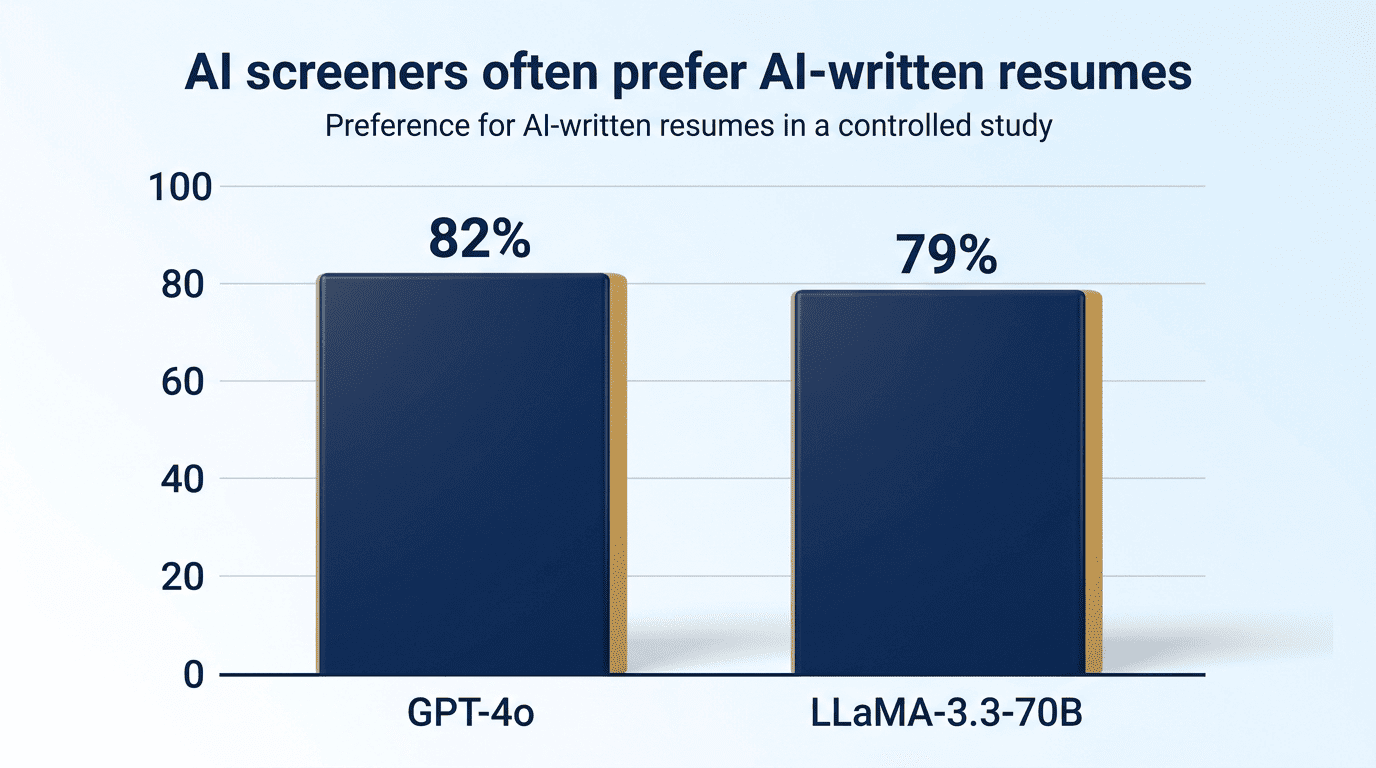
The effect isn’t uniform across fields, but the direction is consistent: language models tend to prefer text that resembles their own output. With a large share of companies reporting plans to use AI to screen resumes, that self-preference bias is not a fringe concern.
Where AI Resumes Backfire (and How to Not Be That Candidate)
Every source converges on the same failure mode: AI can get you past the screen, but it cannot sit in the interview for you. Three backfire points show up again and again once a candidate reaches the interview stage:
- Behavioral interviews demand real, specific stories — the exact thing generic AI phrasing can’t supply because it was never grounded in an actual event.
- Inflated or fabricated numbers collapse under a single follow-up question, because a made-up 40% improvement has no real project behind it to describe.
- Skills-section overreach gets exposed fast in a technical screen, where a listed skill either produces a working answer or it doesn’t.
Recruiters have adapted with a simple, repeatable test: pick any bullet on the resume and ask the candidate to unpack it — what did you actually do in week one, what specifically broke, how did you measure the result. One useful way to pressure-test your own bullets before an interview is the SOAR method:
- Situation — What was the actual context or problem?
- Obstacle — What specifically made it hard?
- Action — What did you, personally, do?
- Result — What changed, with a number you can defend?
Run every AI-polished bullet through those four questions before you submit the resume. If you can’t confidently explain a line under follow-up questioning, it doesn’t belong on your resume.
Cautionary anecdotes like this show up repeatedly in recruiter accounts: a candidate’s AI-polished resume lists a credential from a school that turns out not to exist, invented wholesale by the tool during drafting. Employers increasingly cross-reference LinkedIn during review, and any inconsistency between the two profiles reads as a red flag regardless of how it got there.
Fabrication isn’t just a risky move — it’s the one thing that turns «I used AI» into «I lied.» Everything else in this guide is negotiable stylistic territory; invented facts are not.
How to Use an AI Resume Writer the Right Way (Hybrid Workflow)
The winning approach in 2026 is hybrid: you own the facts, AI owns the polish. Used this way, an ATS-friendly AI resume writer is a legitimate drafting aid rather than a shortcut around honesty. Here is the workflow the top sources agree on.
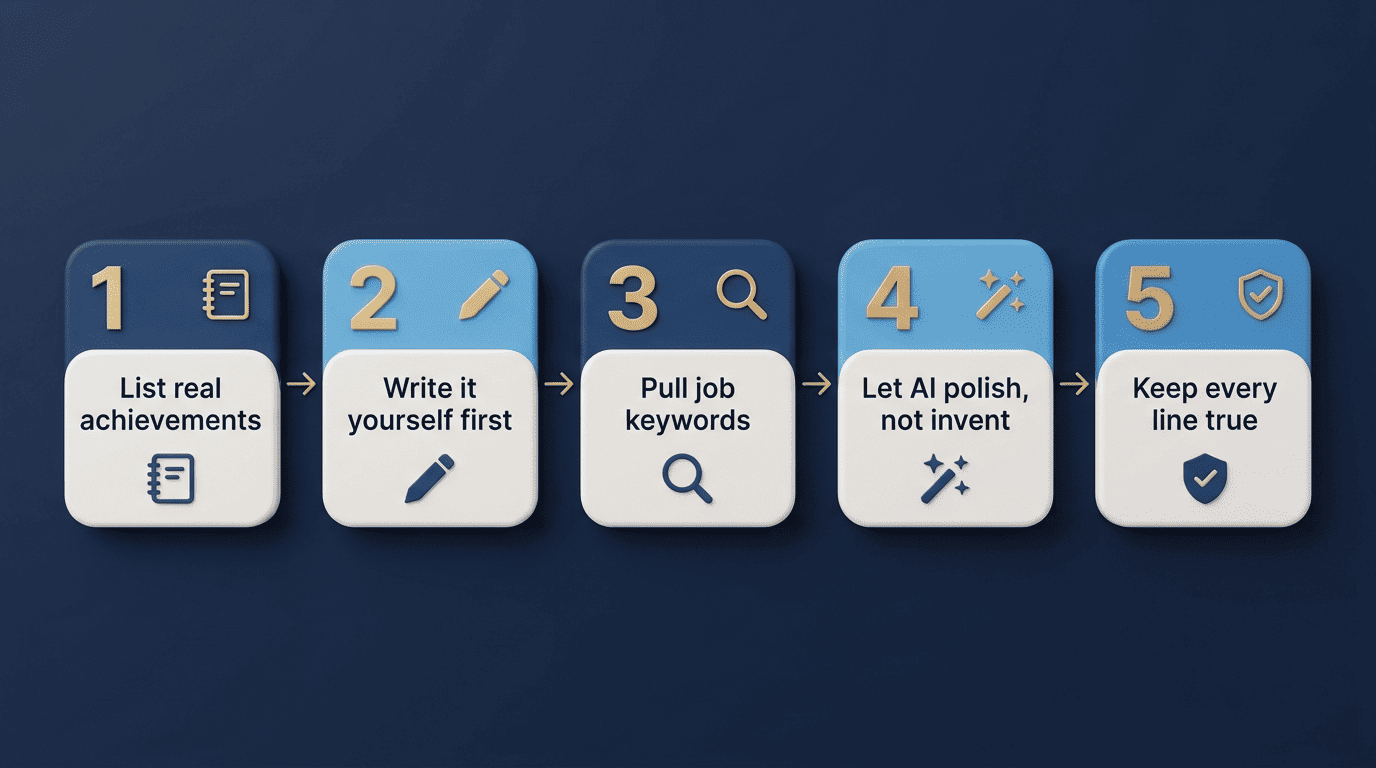
Step-by-step hybrid method
- Build an evidence bank first. Before opening any tool, list your real achievements, numbers, projects, and responsibilities in plain language.
- Write a master resume in your own words. This becomes your ground truth — the document every AI-assisted draft gets checked against.
- Decode the job description. Pull 15–25 exact-match keywords and phrases verbatim from the posting.
- Use AI only to map evidence to the job. Have it rework existing, true bullets to match the role — never to invent new ones. Letting AI write the experience bullets from scratch is the single biggest mistake candidates make.
- Force specificity. Insist on metrics, timeframes, scope, and tools that AI cannot invent on its own — these have to come from you.
- Run an ATS formatting pass. Use plain, parseable formatting and aim for a keyword match score above 80 (70 as an absolute floor) using a tool such as Jobscan.
- Do a human-voice pass. Vary bullet structure, restore phrasing that sounds like you, and strip out buzzword uniformity.
- Read it aloud — the «coffee test.» Confirm every single fact is true and something you could defend, unprompted, in an interview.
An AI-generated resume built this way — real evidence first, AI polish second — is what separates candidates who pass the interview from candidates who only pass the screen.
Skip the «humanizer» tools
«Humanizer» tools that scramble AI-written text to dodge detectors generally aren’t worth the effort. Almost no recruiter runs a detector in the first place, and scrambling the prose tends to make the writing worse, not safer. Fix the substance — real facts, real specifics — not the surface-level word choice.
Are Some Industries Stricter About AI Use?
Yes. Context changes the answer.
Academia, journalism, and legal fields hold original authorship to a noticeably higher bar. In those fields it pays to use AI more sparingly, and more visibly as a light editing pass rather than a drafting engine.
Tech, consulting, business, and most corporate roles treat AI-assisted writing as standard practice. Nobody expects a candidate applying for a product-management or sales role to have handwritten every line without any drafting help.
| Field type | Typical norm on AI-assisted resumes | Examples |
|---|---|---|
| Stricter-norm fields | Use AI sparingly, as a light editing pass | Academia, journalism, law |
| Broadly-accepted fields | AI-assisted writing is standard practice | Tech, consulting, business, corporate roles |
The stricter scrutiny isn’t limited to how candidates write. The AI tools employers use to screen candidates are increasingly regulated too:
- The EEOC’s own May 2023 guidance — archived after the agency pulled AI-related guidance from its site in 2025 — stated that employers can be held liable under Title VII for AI hiring tools that create a disparate impact, whether the tool was built in-house or bought from a vendor. The guidance page is no longer live on eeoc.gov, but Title VII’s disparate-impact rules were not repealed, so the underlying legal exposure remains.
- New York City’s Local Law 144 requires independent bias audits plus candidate notification for automated employment-decision tools.
- Illinois and Colorado have enacted their own AI-hiring regulatory frameworks.
The stakes behind that regulation are not abstract: University of Washington research found that AI resume-screening tools favored white-associated names over Black-associated names in a large majority of tested comparisons (85% vs. 9%), and favored male-associated names over female-associated names by a similarly wide margin (52% vs. 11%). In most U.S. states, candidates currently have no legal right to request a human reviewer in place of an automated one — one more reason a clean, honest, well-matched resume matters on the candidate’s side of the process too.