
How to Use an AI Resume Writer to Tailor Your Resume to a Job Description
Sending the same generic resume to every opening is the fastest way to get filtered out before a human ever reads it. An AI resume writer reads the job description, finds the skills and keywords that posting actually asks for, and helps you reframe your real experience to match — in seconds instead of an hour.

Tailoring isn’t about tricking the system. It’s about making the relevant parts of your background easy to see for both the software that screens resumes and the recruiter who reads them. The U.S. Department of Labor puts the same idea plainly for job seekers: «As you apply for jobs, tailor your resume to the position’s requirements. Study the job opportunity announcement and emphasize the parts of your work history that match the qualification requirements listed there,» according to the Department of Labor’s federal resume guidance. This guide walks through what tailoring means, how to do it step by step with an AI resume tailoring tool, and where honesty has to draw the line. An AI resume writer helps you write and improve a resume and present your experience clearly — it does not guarantee a job.
What «tailoring a resume to a job description» actually means
Tailoring means adjusting an existing resume so it speaks directly to one posting — surfacing the most relevant achievements, mirroring the language of the job ad, and cutting what doesn’t apply. It is not inventing a new career or a new job history. A recruiter typically spends only a handful of seconds on the first pass of a resume, so the top third of the page has to echo the role immediately or the rest may never get read.
It’s targeting, not rewriting from scratch
An AI resume tailor works from the resume you already have. It doesn’t erase your history and start over; it re-orders and re-words the same facts so the most job-relevant ones surface first. Think of it as a filter, not a generator of a new professional identity.
Tailoring in practice usually looks like this:
- Reordering bullet points so the most relevant achievements sit at the top of each role
- Swapping generic phrasing for the exact terms the job description uses, where they genuinely apply
- Trimming or cutting older, unrelated experience that crowds out what matters for this posting
- Adjusting the summary line at the top so it speaks to this specific role, not a generic version of your career
Why one resume can’t fit every job
Two postings with the same title can ask for completely different tools, seniority levels, and priorities. A «marketing manager» role heavy on paid ads needs different keywords than one focused on content strategy. Human resources specialists — the people who often screen these applications before a hiring manager sees them — are a large and growing occupation: the Bureau of Labor Statistics projects about 81,800 openings a year for the role, which means thousands of people reading resumes for fit every single day. A tailor resume to job description with AI workflow compares your resume against each posting and shows the gap, so you’re not guessing which version to send.
How ATS keyword matching works (and where AI helps)
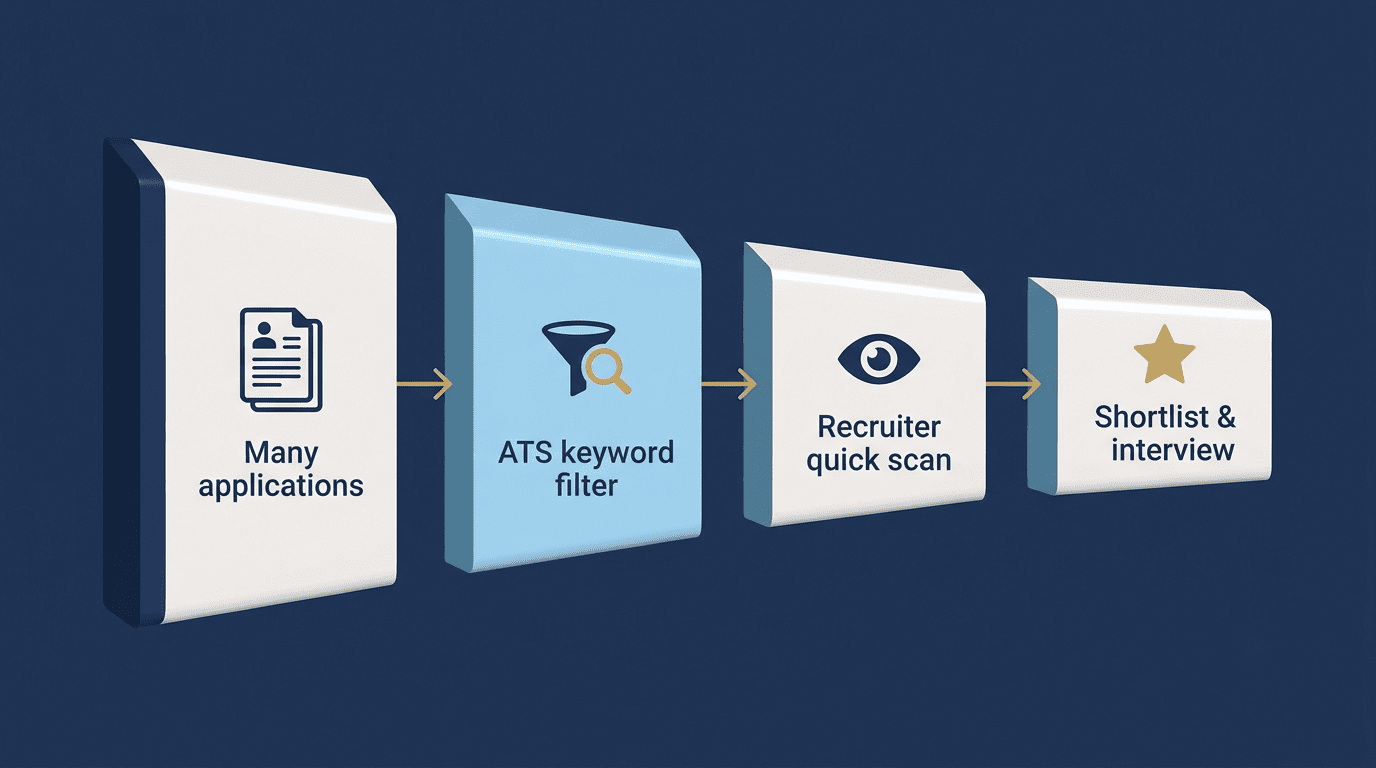
Most mid-size and large employers route applications through an Applicant Tracking System (ATS) such as Workday, Taleo, or Greenhouse before a person ever opens the file. These systems parse your resume into structured fields — job titles, dates, skills, education — and then rank or filter candidates, often by how closely your text matches the job’s required skills and titles.
The screening layer before a human
An ATS is not reading for tone or personality; it’s matching strings and structured data. If your resume calls a skill «customer support» and the posting says «client success,» a keyword-matching engine may not connect the two on its own. That’s the specific gap an AI resume optimizer is built to close.
What the AI actually changes
A good AI resume writer extracts several things from a job posting before it touches your resume:
- Required and preferred skills, listed explicitly in the posting
- Specific tools, software, or platforms named (for example, Salesforce, Excel, or a coding language)
- The exact job title and any seniority language («senior,» «lead,» «manager»)
- Recurring phrases that show up more than once, which usually signal priority
It then checks which of those your resume already supports, and suggests where to add or reword them using your real experience. Many tools show a match score so you can see the before-and-after difference at a glance. Keep formatting clean and parseable — simple headings, standard section names, no text boxes or graphics hiding content — because a plain .docx is often safer than a heavily designed PDF for older ATS software.
| ATS keyword factor | Why it matters | What the AI resume writer does |
|---|---|---|
| Job title match | Systems often rank exact or near-exact title matches higher | Suggests the posting’s title language where it’s accurate |
| Skill/tool keywords | Missing required tools can auto-filter a resume out | Flags missing terms you actually have experience with |
| Formatting | Tables, columns, and graphics can break parsing | Recommends a clean, single-column, standard-section layout |
| File type | Some legacy ATS misread heavily designed PDFs | Suggests .docx or a simple PDF export |
Step by step: tailoring with an AI resume writer
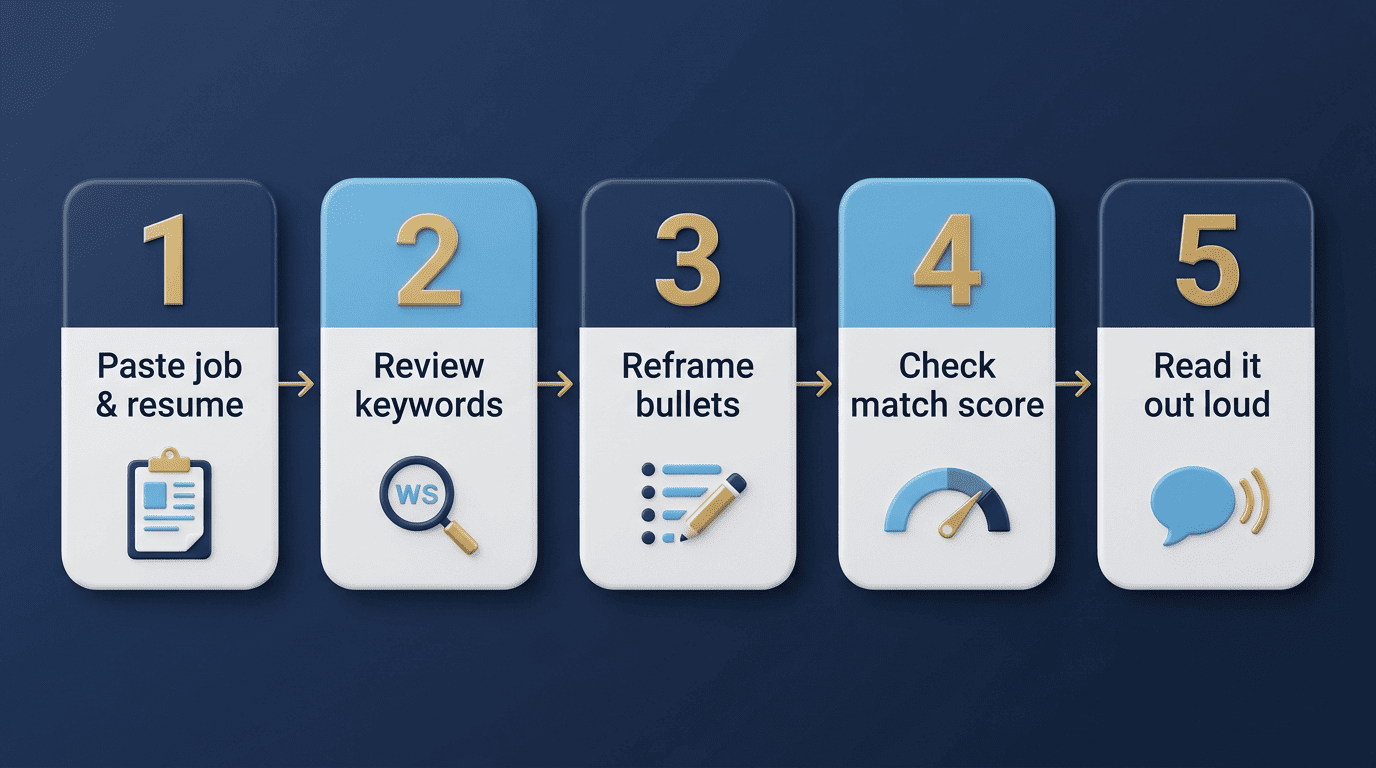
Most AI resume tailoring tools follow roughly the same workflow. Here’s how to run it well instead of just clicking «generate» and hoping for the best.
- Paste the job description and your current resume. Give the tool both inputs in full. It reads the posting the way an ATS would and maps its requirements against your existing content.
- Review the suggested keywords and gaps. The tool highlights matched versus missing skills. Add only the ones you genuinely have — a missing keyword you can’t back up in an interview is a signal to build the skill, not to fake it.
- Let it reframe bullet points, then edit. The AI rewrites bullets to lead with the action and end with a measurable result, following the CAR/STAR pattern: what you did, how you did it, and the outcome. Treat the output as a draft — fix any number it guessed, restore your own voice, and cut filler.
- Re-check the match score and formatting. Aim for a strong but not perfect match; many guides suggest roughly a 60-70% keyword overlap is plenty for most postings.
- Read the whole resume out loud once more before you save it, checking that every claim is still true after the edits.
Aim for that strong-not-perfect match: a 100% keyword match usually means the resume has been stuffed, which tends to hurt more than it helps.
Honest tailoring vs. keyword stuffing and fabrication
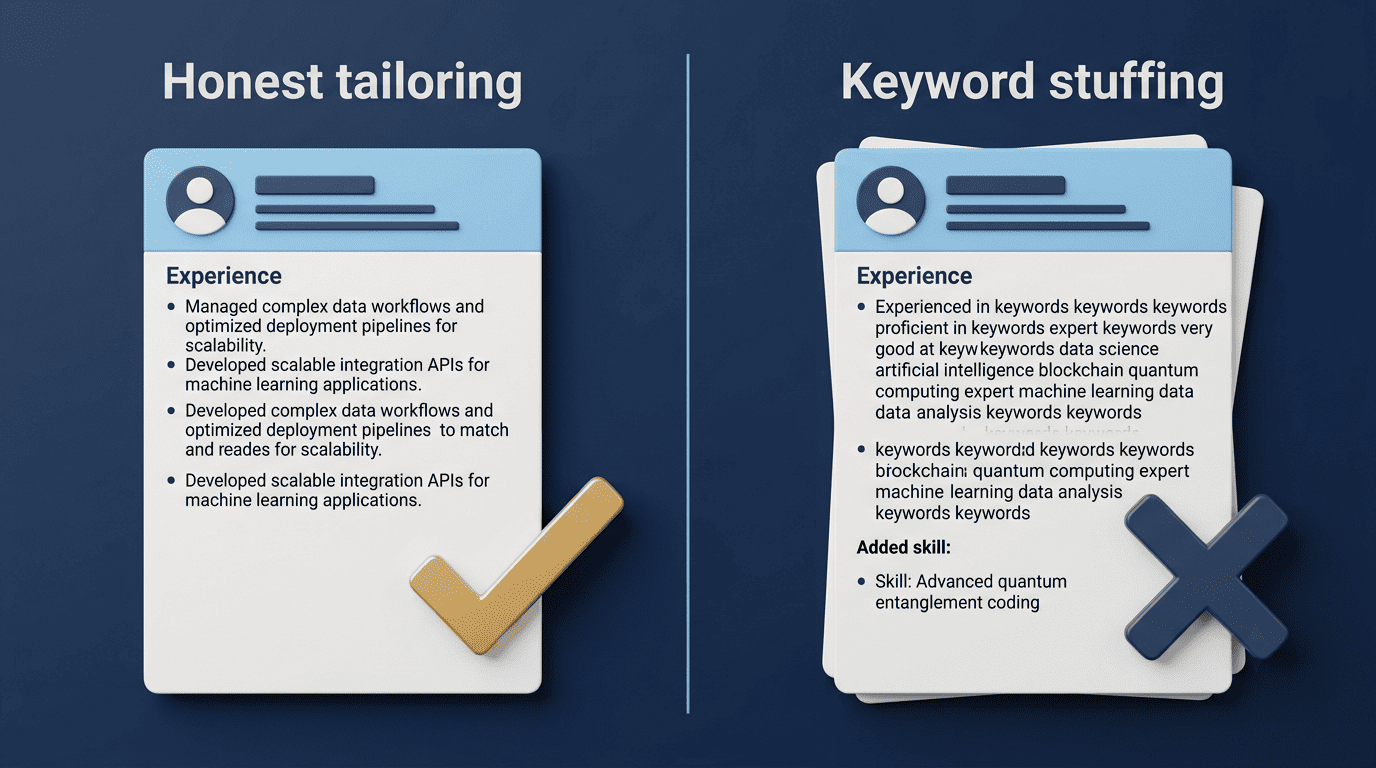
This is the part where an AI resume writer has to stay a tool you supervise, not an autopilot. The line is simple: reframe what you actually did, never claim what you didn’t. An AI resume optimizer should highlight and reword real achievements — never invent a job title, degree, certification, or skill you don’t have.
As you apply for jobs, tailor your resume to the position’s requirements. Study the job opportunity announcement and emphasize the parts of your work history that match the qualification requirements listed there.
U.S. Department of Labor, Tips for Writing a Federal Resume
The line you don’t cross
Fabrication is easy for an interviewer to catch — a follow-up question about a «skill» that isn’t real usually unravels fast, and it can cost you the offer or the job later, sometimes after you’ve already started. Use the tool to make real achievements legible, not to invent new ones.
Why stuffing backfires
Cramming every keyword from the posting into your bullets makes the resume read like a machine wrote it, and recruiters notice. An obviously AI-sounding tone tends to lower response rates rather than raise them. Match the important terms naturally, keep your own phrasing where it still reads well, and let real numbers do the persuading instead of keyword density.
What to review before you send
Passing the ATS is the first hurdle, not the last one. A person still makes the final call, and that person is reading for fit, not just for keywords.
The human reads next
Once you clear the ATS, a recruiter or hiring manager decides whether to move you forward. Read the resume out loud: does it sound like you, are the top achievements relevant to this specific role, and is every claim still true after the AI’s edits? Many AI resume writers also draft a matching cover letter — the same rule applies there: personalize it for the company and keep it honest.
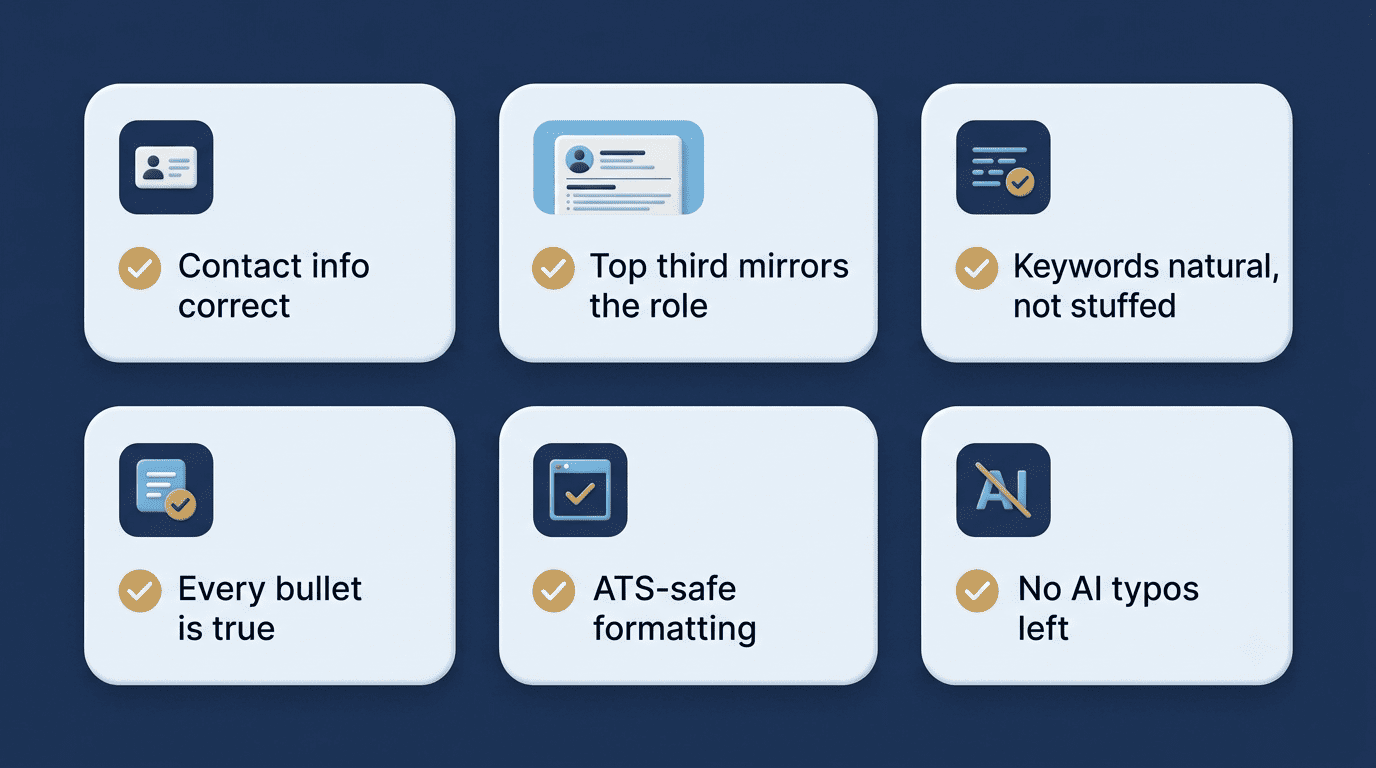
A quick pre-send checklist
- Contact info is correct and current
- The top third of the resume mirrors the language of the role
- Keywords are present but read naturally, not stuffed
- Every bullet is true and quantified where possible
- The format is clean and ATS-parseable (standard headings, no graphics hiding text)
- No typos the AI introduced during rewriting
Choosing an AI resume writer for tailoring
Not every resume tool handles tailoring the same way, and the differences matter more than the marketing copy suggests.
| What to check | Why it matters |
|---|---|
| Transparent match score | Lets you see exactly what’s matched vs. missing, not just a vague «optimized» label |
| Edits from your own resume only | Prevents the tool from inventing content you’d have to fact-check line by line |
| ATS-safe formatting output | Keeps the file parseable by common ATS platforms |
| Editable, reviewable suggestions | Keeps you in control of every claim before you send it |
| Cover letter pairing | Saves time by drafting a matching letter alongside the tailored resume |
Look for a tool that shows a transparent match score, edits from your own resume with no invented content, keeps formatting ATS-safe, and lets you review every change line by line. An ATS-friendly AI resume writer that pairs tailoring with a cover-letter draft saves the most time — as long as you stay in the editor’s seat and keep every claim honest.