
AI Resume Writer Bullet Points: Turn Weak Lines Into Interview-Ready Ones
An AI resume writer bullet point generator takes a plain job title or a tired line like «responsible for sales» and rewrites it into a sharp, metric-driven achievement — the kind recruiters and applicant tracking systems actually reward. A good AI resume builder does the heavy lifting on phrasing and structure, then hands you a draft to sharpen with your real numbers.

This guide shows exactly how AI generates resume bullet points, what makes a bullet strong, and how to edit the output honestly so every line is both compelling and true. Worth saying up front: an AI resume writer helps you draft and improve your resume; it does not guarantee a job. You are responsible for keeping every bullet accurate to your real experience.
What an AI Resume Bullet Point Generator Actually Does
A bullet point generator turns basic role context — job title, company, seniority, industry — into ready-to-edit lines that already follow resume conventions. Kickresume’s generator, for example, runs on OpenAI’s GPT-4.1 and was trained on resume best practices, thousands of job descriptions, and recruiter feedback, so the output is shaped like a real accomplishment rather than generic prose. Rezi reports 4 million-plus job seekers since 2019, rated 4.5 out of 5 on Trustpilot across 129 reviews, while Kickresume cites 7.5 million-plus resumes created — a signal of how mainstream AI-assisted bullets have become.
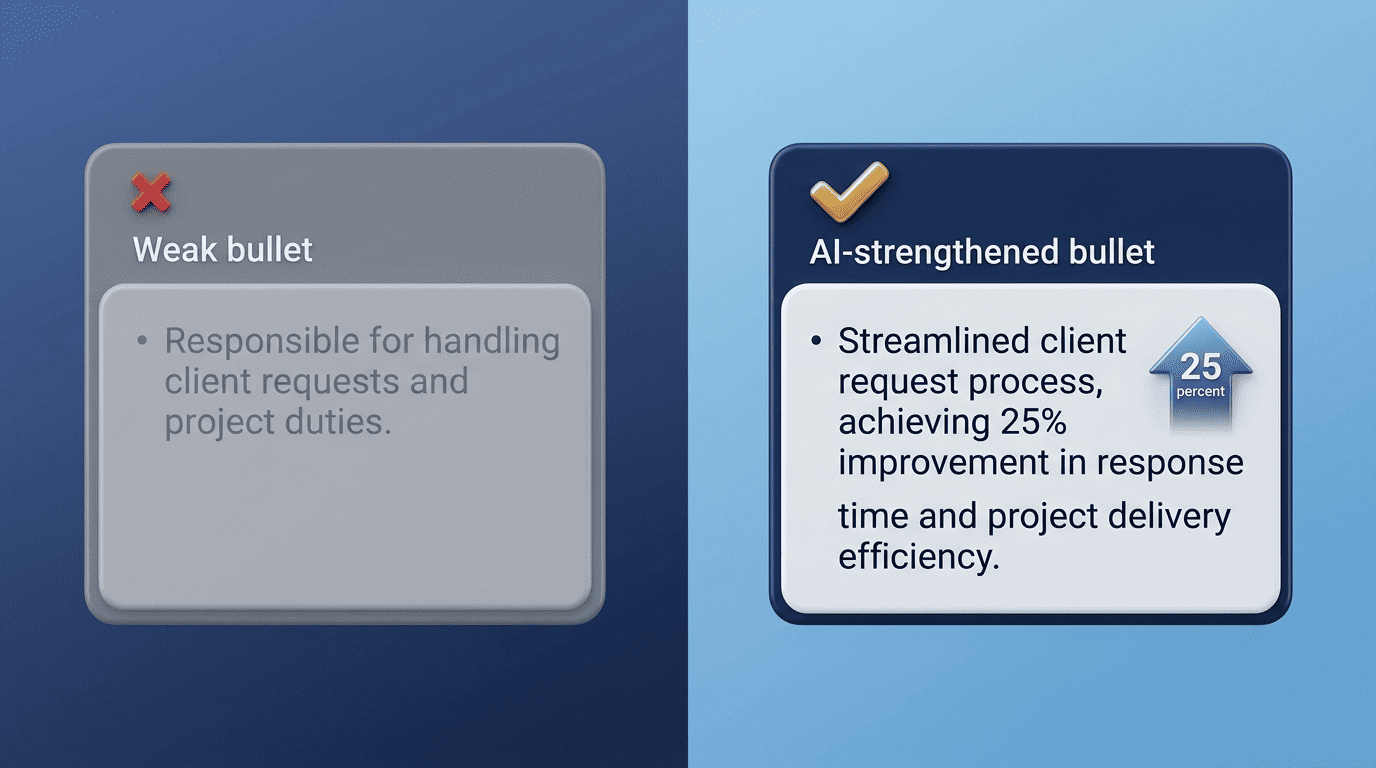
Specific input equals smarter output
The tools agree on one thing: vague input yields vague bullets. Rezi notes that a specific prompt like «Marketing Manager at Google» produces far smarter results than «manager.» Treat the generator as a co-writer for the work experience section — feed it your role, tools, and rough outcomes, and it returns structured phrasing you refine, not a finished paragraph you paste blind.
The Anatomy of a Strong Bullet Point
A strong bullet point is specific, quantified, action-oriented, relevant to the target role, and concise. Every part of that definition maps to something an AI resume bullet point generator is built to enforce by default, though it still needs your real details to fill in.
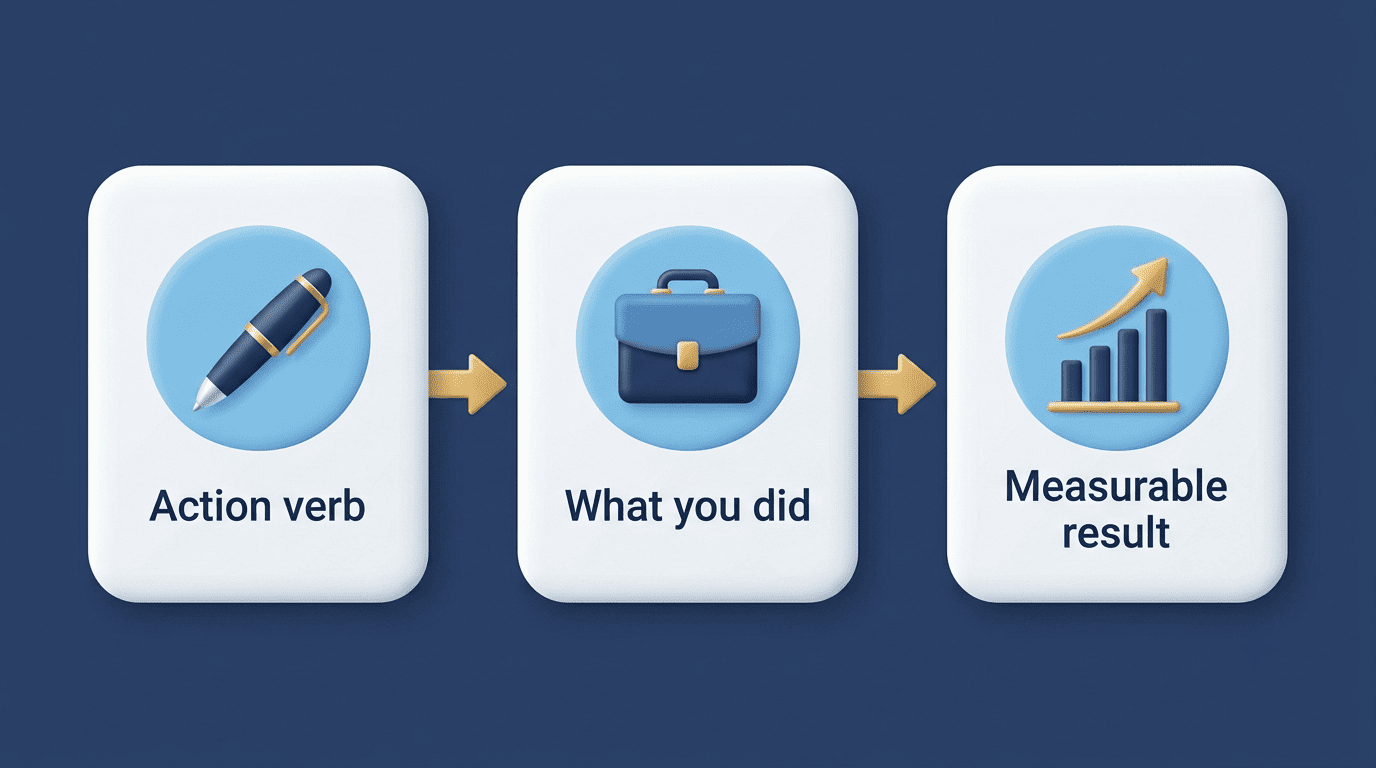
Start with an action verb
Every strong bullet opens with a strong verb, not «responsible for.» University career centers publish action-verb lists precisely because verb choice signals ownership and impact; Harvard’s Mignone Center for Career Success maintains resume guidance along these lines for exactly this reason. AI generators bake this in: Kickresume and Rezi both open bullets with action verbs by default. A few reliable openers by category:
- Leadership: led, managed, directed, mentored
- Growth: increased, expanded, scaled, generated
- Efficiency: automated, streamlined, reduced, consolidated
- Creation: launched, built, designed, developed
Quantify the result
The single biggest upgrade is a number. Resume Genius illustrates it plainly: turn a flat line into «increased sales by 25%» or «trained 3 new team members.» If you don’t have exact figures, use honest, defensible estimates or ranges — never invented numbers. Quantifiable metrics worth mining from your own history:
- Percentages (growth, cost reduction, error rate)
- Dollar amounts (revenue, budget managed, savings)
- Headcounts (people trained, hired, or led)
- Time saved (hours per week, turnaround time)
- Volume (units shipped, tickets closed, accounts managed)
Keep it concise and relevant
Strong bullets stay achievement-focused and roughly one to two lines each. Cut filler; keep the accomplishment. A bullet that reads well but hides the actual result underneath adjectives isn’t doing its job.
| Weak bullet | AI-strengthened bullet |
|---|---|
| Responsible for sales in the region | Increased regional sales 25% over two quarters by restructuring the outreach cadence |
| Helped train new hires | Trained 3 new team members, cutting onboarding time from 4 weeks to 2 |
| Worked on customer support tickets | Resolved 40+ support tickets weekly, maintaining a 96% satisfaction score |
| In charge of the marketing budget | Managed a $120K marketing budget, reallocating spend to cut cost-per-lead 18% |
Proven Formulas: STAR and XYZ
Two structures show up again and again across AI resume bullet point generators, and understanding both helps you judge whether the AI’s draft is actually well-built or just wordy.
The STAR method
Himalayas structures bullets with STAR — Situation, Task, Action, Result — so each line captures context, your responsibility, the action you took, and the outcome. The STAR method is a widely used behavioral framework, also common in interview answers, which is part of why it translates cleanly to resume bullets: it’s already the shape recruiters expect to hear.
The XYZ formula
A tighter variant popularized for résumés is the XYZ formula: «Accomplished [X] as measured by [Y], by doing [Z].» It forces a result (X), a metric (Y), and a method (Z) into one line — ideal for AI generation because it gives the model a clear template to fill rather than an open-ended sentence to invent.
| Formula | Structure | Best for |
|---|---|---|
| STAR | Situation, Task, Action, Result | Longer bullets with context, or interview prep reuse |
| XYZ | Accomplished X, measured by Y, by doing Z | Tight, one-line, metric-first bullets |
Neither formula is arbitrary. Both were built for the same reason an AI resume bullet point generator is useful in the first place: they force a vague accomplishment into a shape that includes context, a measurable result, and how you got there, instead of leaving it as a duty description. The XYZ formula in particular traces back to a specific, quotable source.
My personal formula for a winning resume: accomplished [X] as measured by [Y], by doing [Z].
Laszlo Bock, former SVP of People Operations at Google
That’s exactly why quantified bullets outperform vague ones: a number gives a recruiter — and an ATS — something concrete to score, instead of a claim they have to take on faith.
Making Bullets ATS-Friendly
Applicant tracking systems parse resumes for keywords from the posting before a human ever reads them. An Applicant Tracking System, per Wikipedia’s overview, is software that manages the recruitment process, including scanning and ranking submitted resumes against a job description — which is exactly the layer your bullet phrasing has to survive.
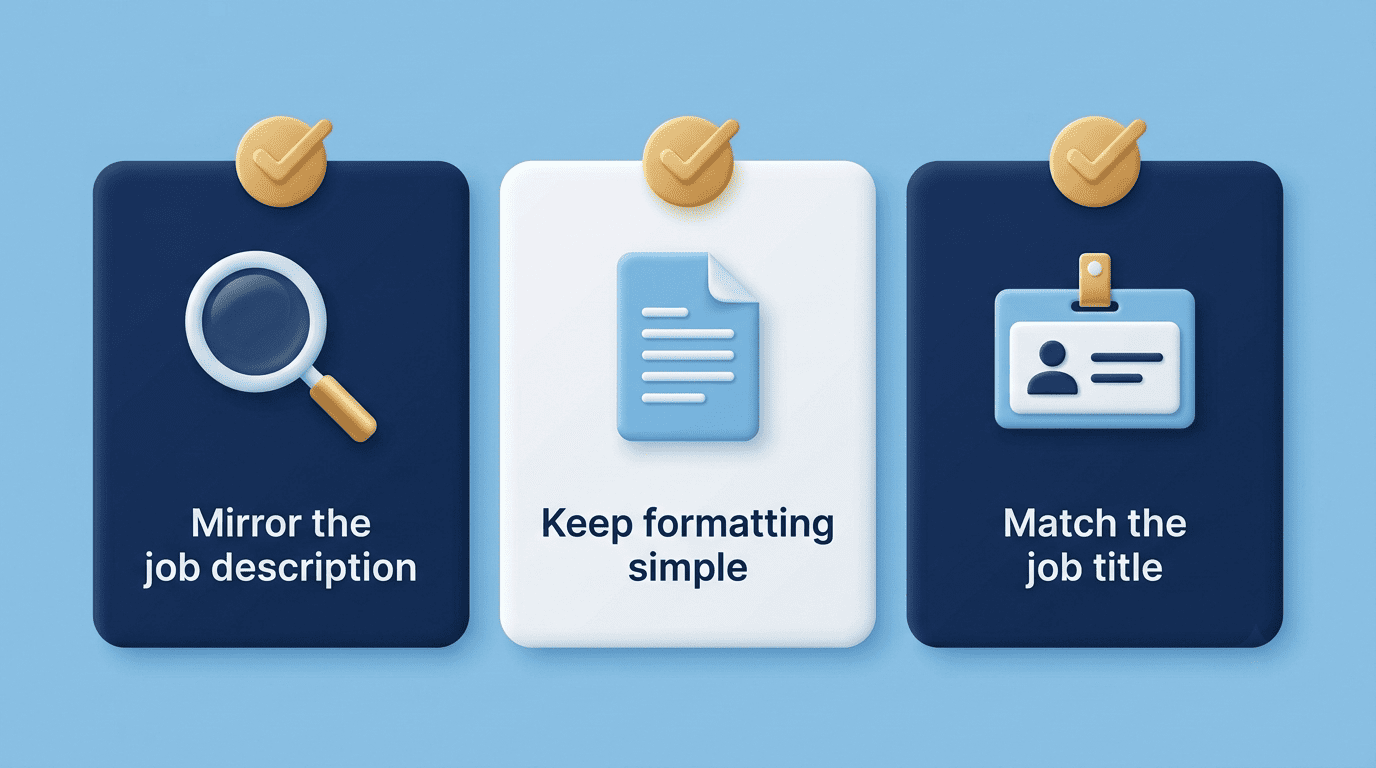
Three habits keep bullets readable by both a machine and a human:
- Mirror the job description. Jobscan’s generator analyzes the job description and injects the right skills and terms so bullets match what recruiters screen for. Paste the target posting, let the AI align your bullets, then confirm each claim is real before you submit anything.
- Keep formatting parseable. Use standard bullet characters and plain text; avoid tables, images, or unusual symbols inside the experience section that ATS parsers can mangle.
- Use the job title language, not just your own. If the posting says «Project Manager» and your internal title was «Program Lead,» an AI resume writer can help you note the equivalent language without misrepresenting your actual role — accuracy and keyword match aren’t in conflict if you word it honestly.
Occupational language also drifts by field, which is worth knowing before you lean too hard on generic verbs. The U.S. Bureau of Labor Statistics publishes standardized descriptions of what different roles actually involve across industries, and cross-checking your bullet language against the terminology for your target occupation can catch mismatches an AI generator won’t flag on its own.
How to Edit AI Bullets Honestly
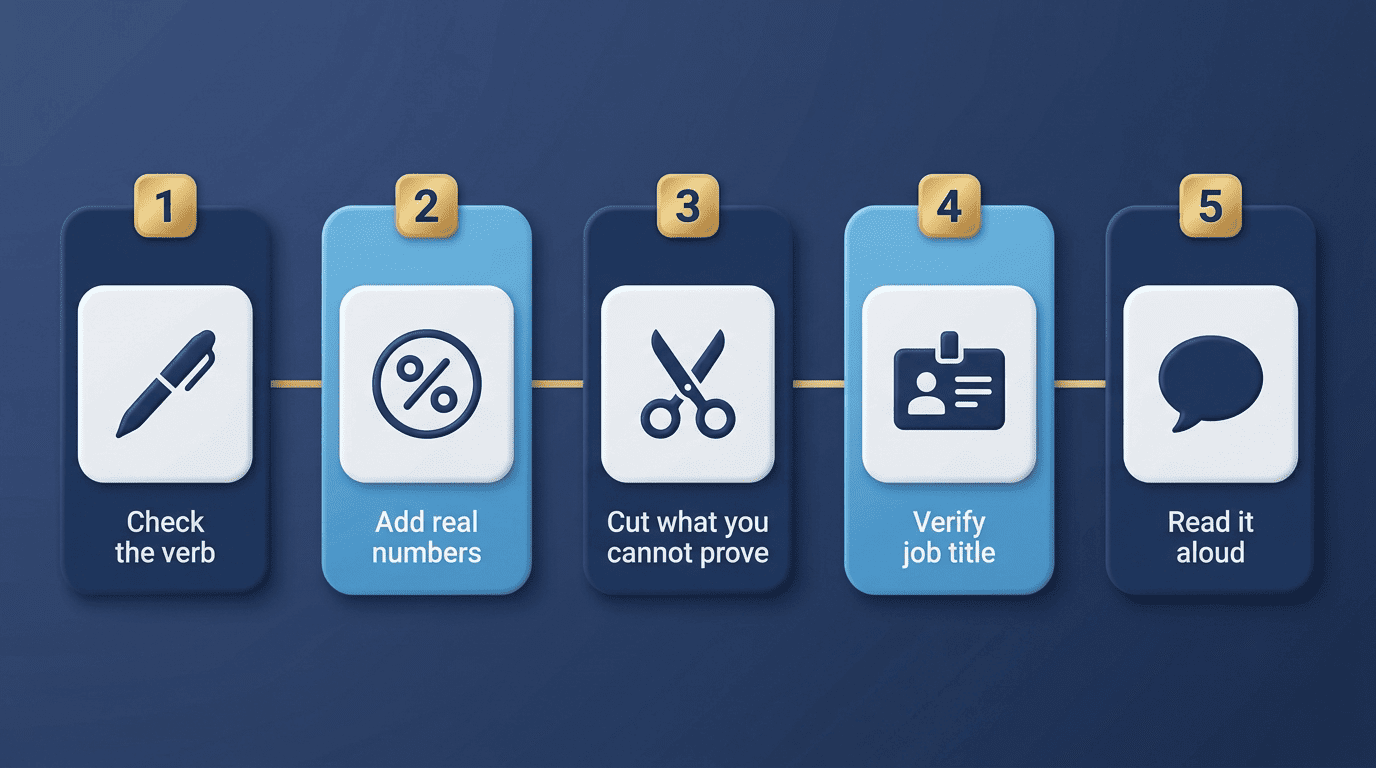
Every tool in this space frames AI bullets as a starting point, not a finished resume. That’s true of any AI resume writer worth using — the draft saves you the blank-page problem, but the editing pass below is what makes it yours. Here’s a short process for turning a generated draft into something you’d defend in an interview.
- Read each bullet and confirm the action verb matches what you actually did.
- Replace every placeholder number with your real metric, or a defensible estimate if you don’t have the exact figure.
- Cut any claim you couldn’t back up if a hiring manager asked a follow-up question.
- Check the job title and scope of responsibility against your actual role — don’t let the AI upgrade your title.
- Match the tone and phrasing to the rest of your resume so it doesn’t read like two different people wrote it.
- Paste the target job description back in and confirm the keywords still line up after your edits.
- Read the whole work experience section out loud once — awkward phrasing usually reveals itself that way.
An AI resume builder can phrase your wins beautifully, but the facts must be yours. Fabricated metrics, titles, or responsibilities can surface in interviews or reference checks, and there’s no AI polish that survives that kind of scrutiny. Honesty isn’t just ethical here — it’s what makes your story hold up once someone asks you to walk through it.
How Many Bullets and How Long
A common convention: 3–6 bullets for your most recent or relevant roles, fewer — 2–3 — for older positions, each one to two lines. Lead with your biggest, most quantified wins, since recruiters skim the top of each role before deciding whether to keep reading. If you’re building the rest of the page around this section, an AI resume maker can help keep bullet length and formatting consistent across every job listed, which matters as much to ATS parsing as the wording itself.