AI Resume Checker: How the Score Works and What It Actually Catches
An AI resume checker uploads your resume, reads it the way an applicant tracking system would, and returns a score plus a list of fixes — missing keywords, weak verbs, formatting a parser might mangle. According to Wikipedia’s overview of applicant tracking systems, these platforms exist to store, sort, and rank job applications long before a human opens the file, which is exactly the read a checker tries to mimic. Used well, an AI resume writer and its checker help you tighten a resume before a recruiter ever sees it; used blindly, the score becomes a number you chase instead of a resume you’d defend.

This guide explains what these tools check, how the scores are built, what a «good» score really means, and — just as important — where an AI resume checker stops being reliable. One thing up front: an AI resume checker helps you improve your resume; it does not guarantee a job, and the facts on the page still have to be truly yours.
What an AI Resume Checker Actually Checks
Every checker is trying to answer the same two questions a real hiring process asks: can a machine parse this, and does a human want to keep reading? It’s a different job than an AI resume builder does — a builder drafts the content, a checker grades what’s already on the page. Enhancv runs a two-tier system for exactly that reason — Tier 1 reverse-engineers ATS platforms such as BambooHR, Greenhouse, Lever, SAP SuccessFactors, and Workday to test how the file actually parses, while Tier 2 judges content quality and recruiter red flags. Resume Worded groups its 30+ checks into four buckets: Impact & Quantification, Brevity & Style, Growth & Leadership, and ATS & Formatting.
The recurring checks across tools
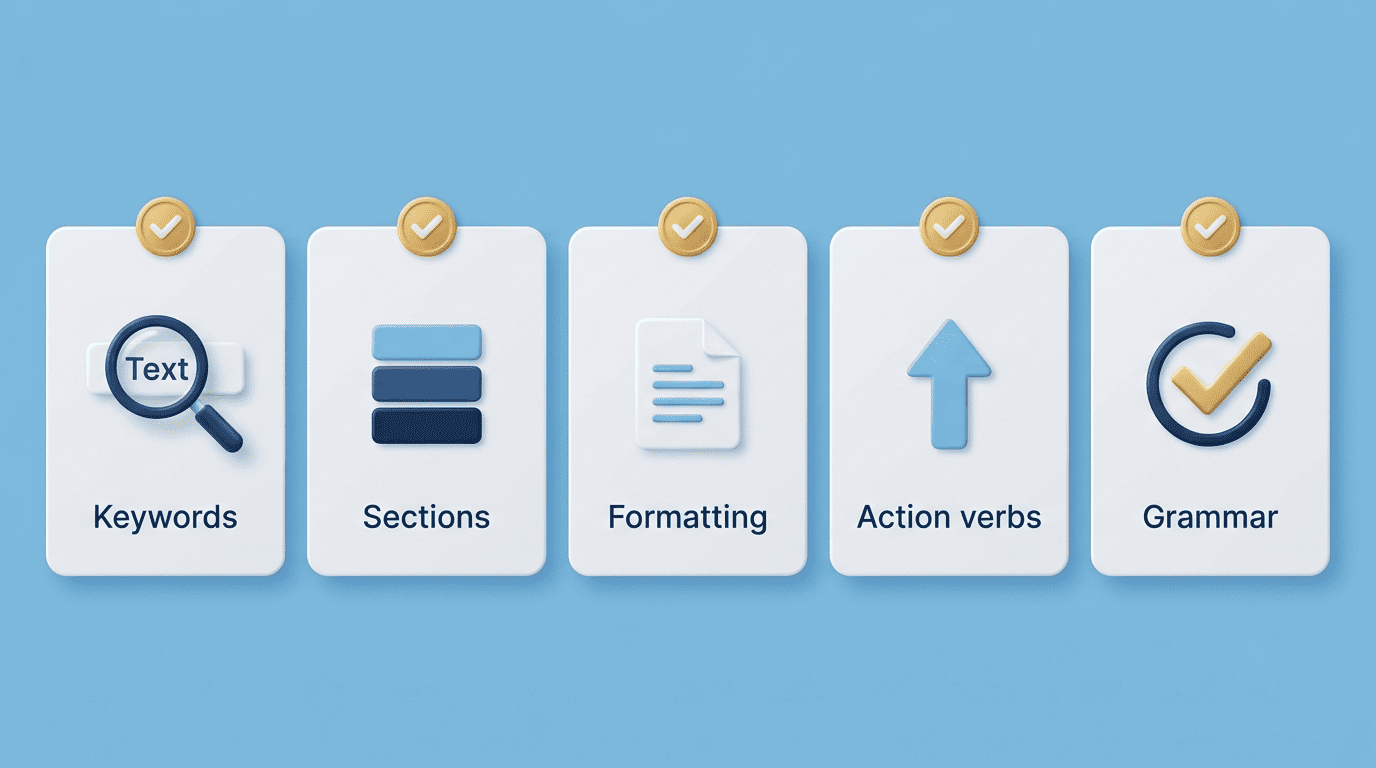
Across the market, the same items keep showing up, just at different depth. Enhancv lists 27 checks across 7 categories, Resume.io runs 16, and Kickresume narrows it to 3: completeness, use of space, and language quality. What they share is a focus on keyword match to the target job description, complete standard sections, ATS-friendly formatting, action-verb strength, quantified results, and grammar.
- Keyword match against a specific job description, not a generic list
- Section completeness — summary, experience, education, skills all present
- Formatting a parser can read: no tables, columns, or embedded graphics
- Action-verb strength — flags weak openers like «assisted» or «helped»
- Quantified results — numbers, percentages, and scope attached to accomplishments
- Grammar, spelling, and consistency (dates, tense, punctuation)
None of these checks are unique to one vendor — they’re a rough industry consensus on what an ATS and a recruiter both notice first, which is why the same fixes tend to show up no matter which checker you run.
How an AI Resume Checker Works, Step by Step
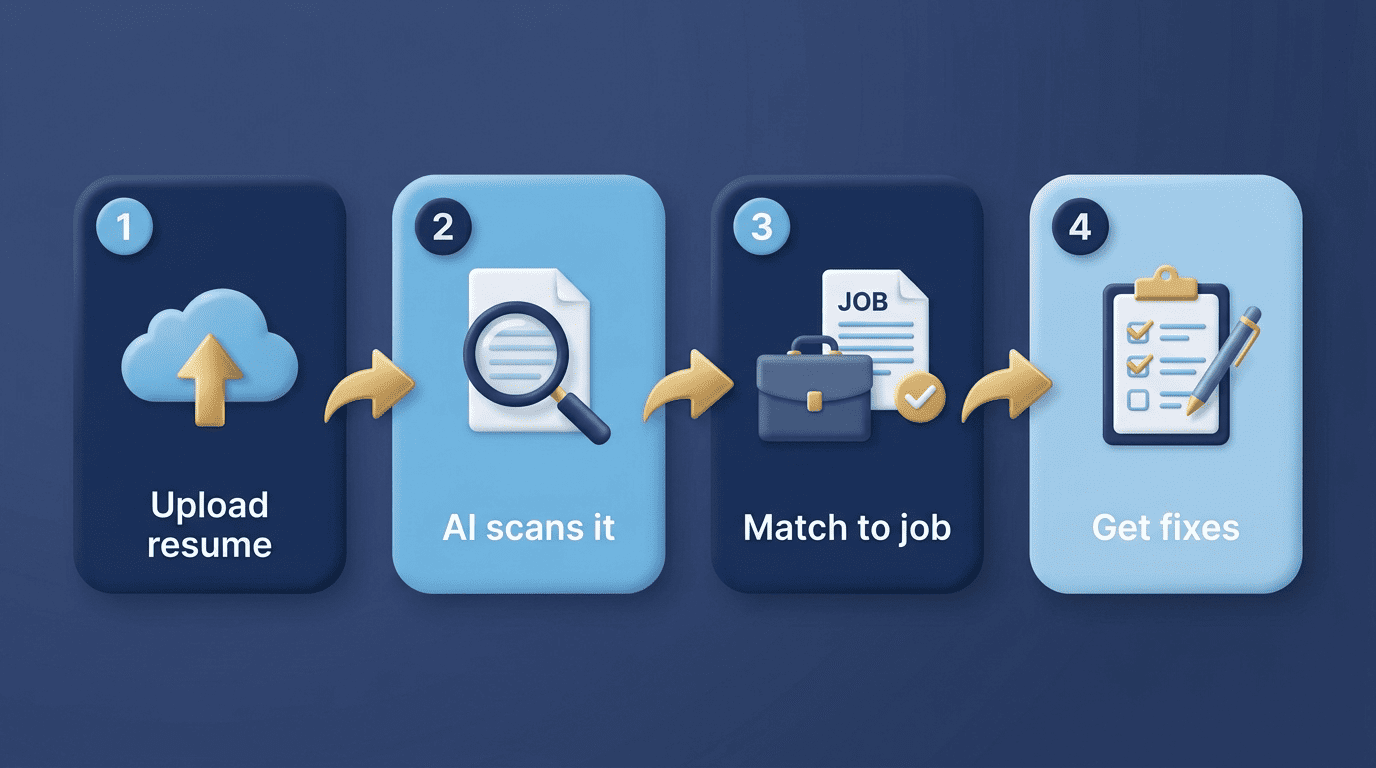
The mechanics are consistent enough across tools that you can describe them as one flow, even though the scoring weights differ. Resume.io breaks its process into four stages, and most competitors follow a near-identical pattern.
- Upload your resume as a PDF or DOCX, typically capped around 2MB.
- The tool runs an initial completeness assessment — are all standard sections present.
- You paste in a target job description for job-matching against that specific posting.
- The checker returns prioritized recommendations, not just a raw score.
- You revise the resume and re-check, closing the highest-impact gaps first.
Under the hood, several of these tools lean on large language models rather than fixed rule sets. Enhancv says its algorithms were built by reading roughly 2,000,000 resumes, layered with OpenAI’s ChatGPT for the content-quality read, and Kickresume runs a GPT-4-powered analyzer designed to mimic how a recruiter would react to the page.
What Counts as a Good Resume Score
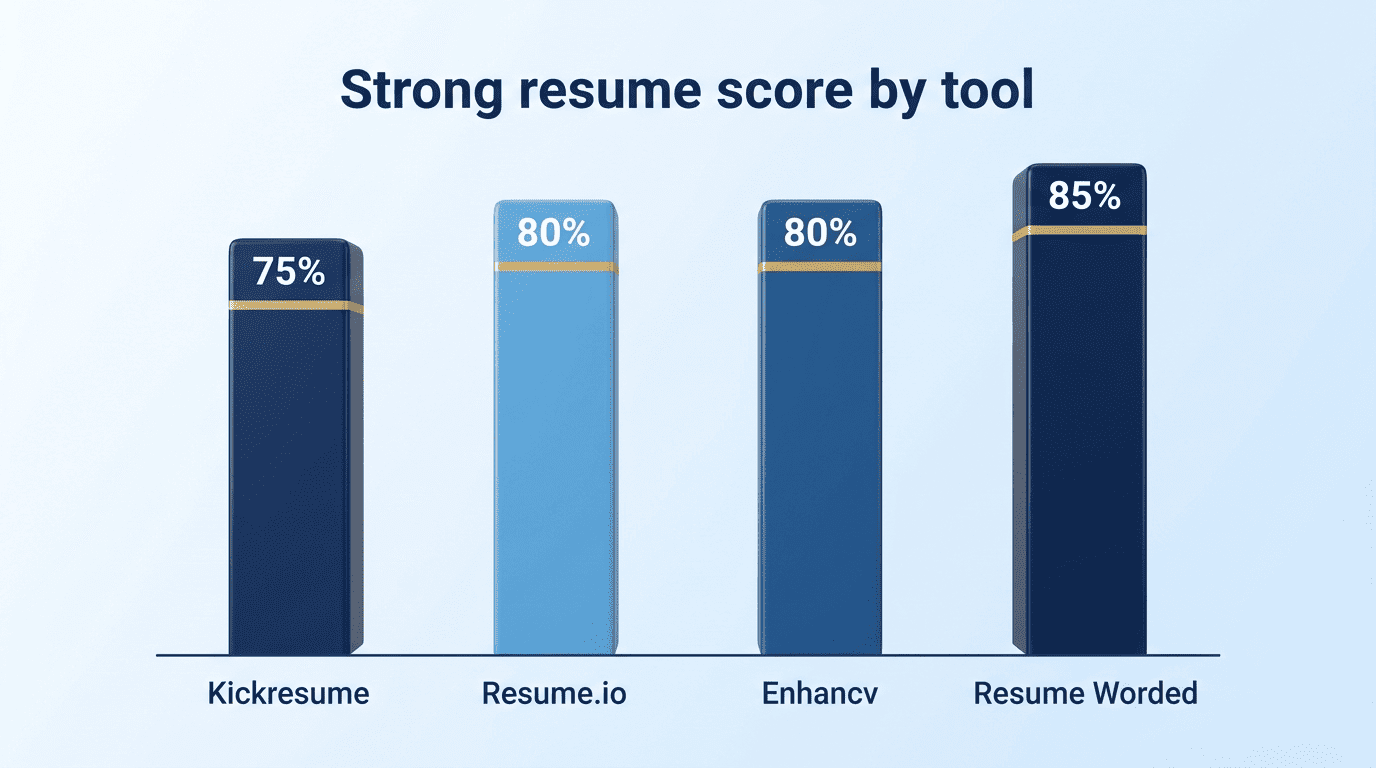
The tools don’t share a scale, but they converge on a rough consensus once you normalize the numbers. That consistency across four independent products is itself a signal worth reading.
| Tool | Strong score | Notes |
|---|---|---|
| Resume.io | 80%+ (90%+ significantly better) | 60-79% moderate, 40-59% needs significant work |
| Resume Worded | 85+ (ideally 90+) on a 0-100 scale | 90-100 «passes every check» |
| Kickresume | 75-100% | Treated as a quality, ATS-optimized resume |
| Enhancv | 80+ | No official universal ATS score exists, per Enhancv itself |
Practically: aim for the high 80s or better on whichever tool you use, and read the specific fixes attached to the score, not just the headline percentage.
Why the number is softer than it looks
Here’s the part most tools bury in the fine print: there is no single, universal ATS score that every employer’s system produces. Enhancv states it directly — no tool online that hands you a score is reading an actual number from the employer’s real ATS. What you get is each vendor’s own estimate, built on its own model of how parsing and ranking probably work.
There’s no such thing as an ATS score. No tool online that provides a score gives an actual score.
Enhancv, resume-checker research notes
Treat any resume score, from any tool including this one, as directional feedback — useful for spotting gaps, not a certified pass mark.
PDF or DOCX, and Formatting That Survives Parsing
Most checkers accept PDF and DOCX up to roughly 2MB, and contrary to older advice still floating around forums, a well-made PDF is usually safe. Enhancv even notes that PDFs can score higher precisely because they’re static and don’t reflow unpredictably the way a DOCX sometimes does inside a parser.
What actually breaks parsing
Layout is the real risk, not file type. Multi-column designs, text boxes, tables, and images placed inside the experience section are the most common causes of dropped or scrambled content. Keep the structure linear — one column, standard headers, no decorative elements competing with the text a parser needs to extract.
- Multi-column layouts and side panels
- Text boxes and floating graphics
- Tables inside the experience or skills section
- Headers and footers holding your contact information
- Scanned images instead of selectable text
Any one of these can cause a parser to drop a whole section rather than misread a single word, which is why formatting mistakes tend to hurt more than a missing keyword.
Where formatting discipline comes from
Good resume formatting borrows directly from plain, professional writing conventions rather than design trends. University writing centers such as the Purdue OWL cover the same fundamentals a parser rewards: clear structure, active voice, and consistent formatting — guidance that predates ATS software but happens to be exactly what these systems read best. Applying those same conventions to a resume costs nothing and works whether or not a machine reads it first.
How Accurate Are AI Resume Checkers?
A checker is a fast first reader, not a hiring manager. It can catch a missing section, a weak verb, or a keyword gap in seconds — things a tired recruiter skimming dozens of resumes might also miss, and things a machine parser will definitely miss if they’re formatted wrong. What it cannot do is judge whether you’re actually the right fit for the role, or whether your story holds up in an interview.
Speed cuts both ways. Resume.io cites research suggesting recruiters spend under seven seconds on a first scan of a resume — which is precisely why a checker’s formatting and keyword fixes matter: there’s no time for a human to dig past a parsing error or a buried qualification.
AI-generated text carries its own risk. Resume.io also references survey data reporting that roughly 49% of hiring managers say they would reject a resume they believed was AI-generated — a reminder that raw, unedited AI output can work against you even when the ATS score looks strong. Personalize anything a checker or writer produces before you submit it.
No checker replaces human judgment. Kickresume states plainly that its checker is an automated tool, not professional human editing, and every other major vendor makes some version of the same disclaimer. Cross-checking your role’s terminology against a neutral, non-commercial source like the U.S. Bureau of Labor Statistics can catch outdated or imprecise wording an AI checker won’t flag, since the BLS documents standard occupational language independent of any resume vendor.
Before you trust a score and hit submit, a few things are worth checking yourself rather than leaving entirely to the tool:
- Does every bullet describe something you can explain in detail, unprompted, in an interview
- Do the job titles and dates match what’s on your LinkedIn profile and references
- Would a recruiter in your actual field recognize the terminology as current
- Does the resume still sound like you if you read it out loud
How to Raise Your Score Honestly
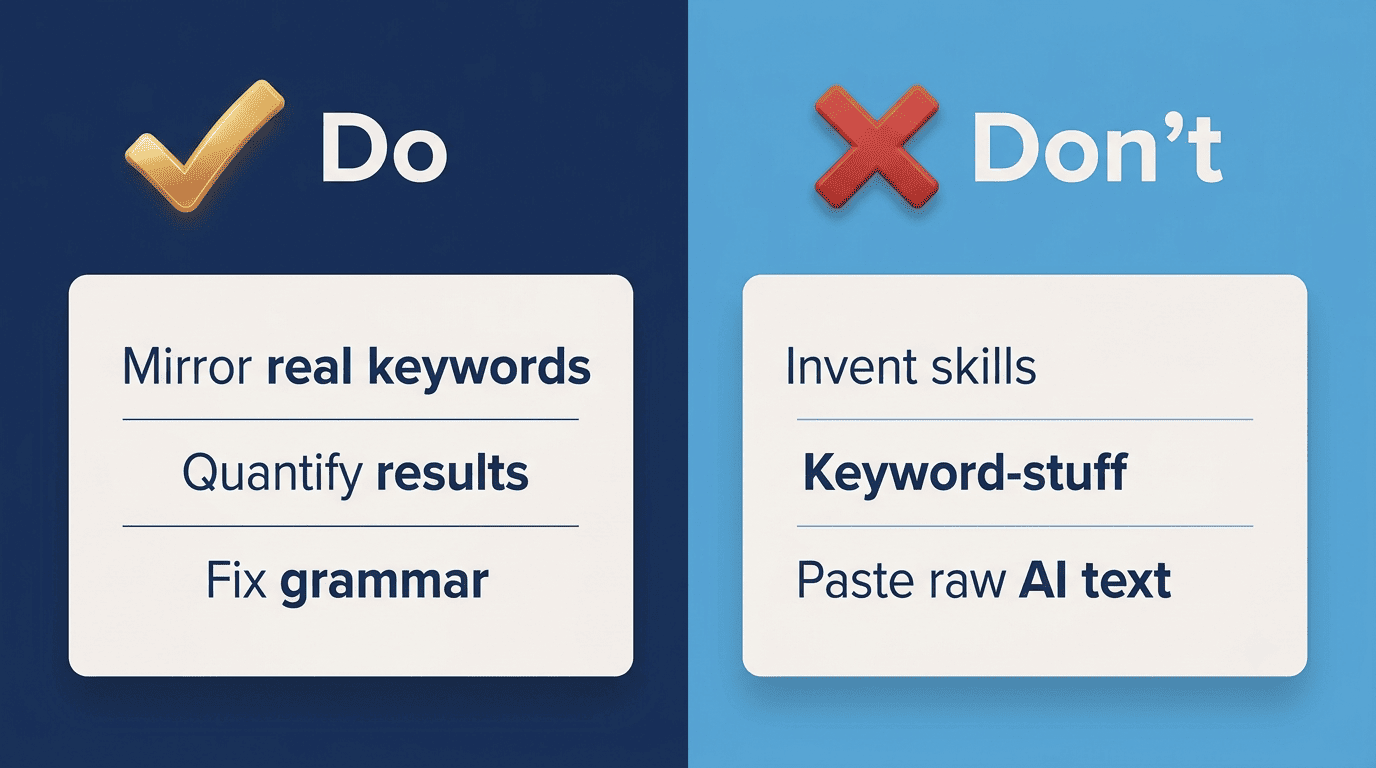
Chase the fixes, not the number. Mirror the real keywords from the posting, quantify achievements with actual figures, replace weak verbs, fix grammar, and make sure every section a checker expects is present and parseable.
- Mirror the exact keywords from the job posting, not synonyms
- Attach a real number, percentage, or scope to each accomplishment
- Swap weak openers («assisted,» «helped») for stronger action verbs
- Fill in any section the checker flags as missing or thin
- Re-run the check after every meaningful edit, not just once
What you should not do matters just as much: don’t stuff keywords you can’t back up in an interview, don’t invent skills or credentials to please the parser, and don’t submit AI-written text describing experience you couldn’t explain out loud. An AI resume maker can raise the score the right way — by making true accomplishments read more clearly — and that’s the only kind of gain that survives a live conversation with a hiring manager.
| Action | Helps the score | Helps the interview |
|---|---|---|
| Mirror real keywords from the posting | Yes | Yes |
| Quantify actual results | Yes | Yes |
| Fix grammar and formatting | Yes | Neutral |
| Invent a skill you don’t have | Yes, short-term | No — backfires |
| Keyword-stuff without context | Sometimes | No — reads as spam |
| Submit unedited AI text as your own | Sometimes | No — risks rejection outright |
A high score on a resume you can’t defend helps no one — not you, and not the recruiter who now has to sort through a claim that doesn’t hold up.